
Words Are Not Merely Words:
They Create Emotion
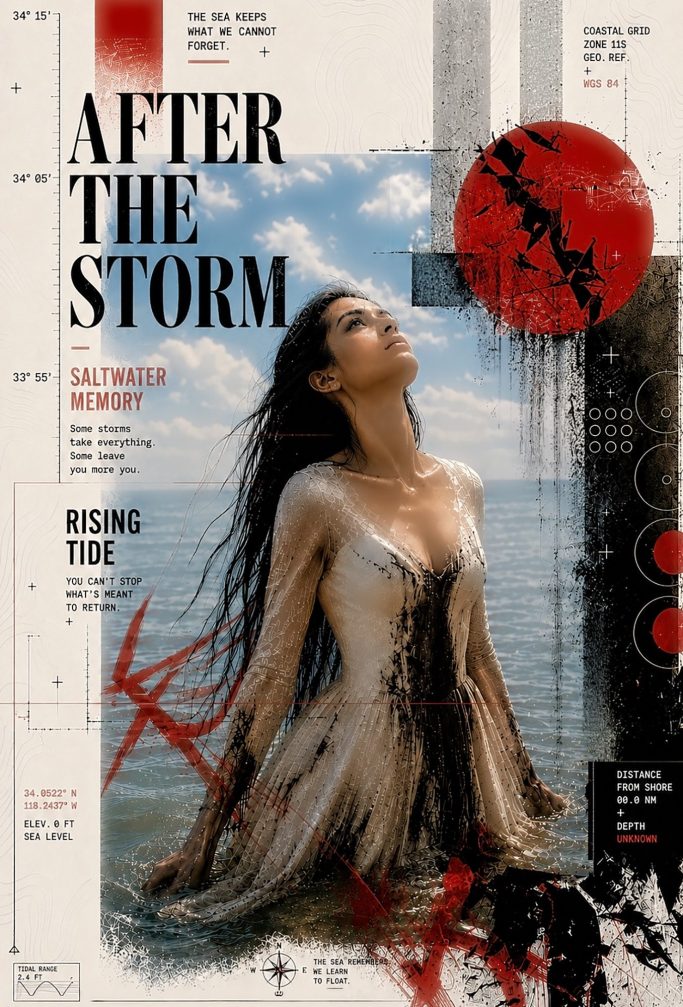
After The Storm: Saltwater Memories
After the storm, she stands where the sea has risen into her dress, as though the tide has chosen her body as its final shoreline. Saltwater runs from her hair, her throat, her open hands. It tastes of grief, of unfinished sentences, of the man whose name she no longer speaks aloud.
Above her, the sky has broken into blue. Clouds drift like torn letters, emptied of accusation. Around her, red circles burn like suns remembered from another life, and black fragments scatter across the horizon, the wreckage of promises finally released.
She remembers love as a room filled with water. At first, they floated together. Then the floor disappeared. She kept reaching for him through the dark, but every touch became distance, every kiss a door closing beneath the waves.
Now the sea lifts and lowers her gently. It does not ask her to forget. It only asks her to loosen her grip.
The storm has washed the old language from her skin. Mud, tears, desire, regret: all of it loosens, dissolves, returns to the deep. Beneath the ruined fabric, something luminous begins to breathe.
She raises her face toward the light, not in surrender, but in recognition. The woman who entered the water is not the woman who will leave it.
Love is gone, yet the horizon remains.
In the cleansing hush, she feels a new beginning stirring like a tide beneath bone. The sea remembers everything but carries nothing forever. It takes what has ended, breaks it into salt, foam and sunlight, then places the future quietly in her hands.
Behind her, the storm becomes a map; before her, morning opens its pale, impossible mouth and sings.
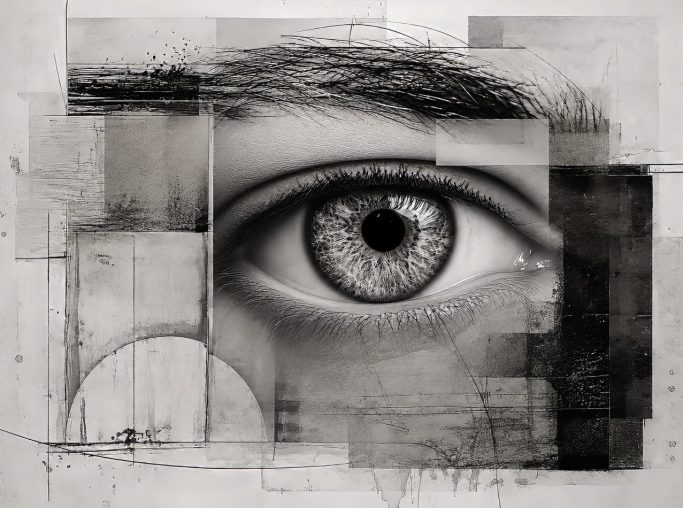
Sometimes I See. Sometimes I'm Blind
Life arrives in fragments: a clear iris, a dark pupil, a thousand scratched lines crossing the face of certainty. I look outward and believe I understand, yet every vision is framed by memory, fear, longing, and the quiet architecture of all I have survived.
Some days the world opens sharply. I notice the tremble of light on water, the kindness hidden in an ordinary gesture, the soft miracle of being here at all. Other days, everything becomes blocks and shadows. I move through myself like a stranger in a ruined house, touching walls where doors once stood.
Perhaps blindness is not the absence of sight, but the refusal to feel. Perhaps seeing is not knowledge, but courage: the courage to remain open when experience has taught us to close.
We are collages, assembled from losses, loves, mistakes, silences, departures, and unexpected returns. Nothing fits perfectly. The edges show. The cracks remain visible. Yet somehow the broken pieces make a face, and the face keeps watching.
My eye does not merely observe; it endures. It has witnessed beauty and damage, truth and deception, beginnings disguised as endings. Still, it refuses to close.
For even blindness can become a teacher, turning the gaze inward and revealing hidden constellations that daylight had quietly erased within.
So I keep looking. Not for answers, but for presence. Not for perfection, but for meaning among the marks.
Sometimes I see the road ahead.
Sometimes I see only darkness.
And sometimes, in that darkness, I finally see myself.
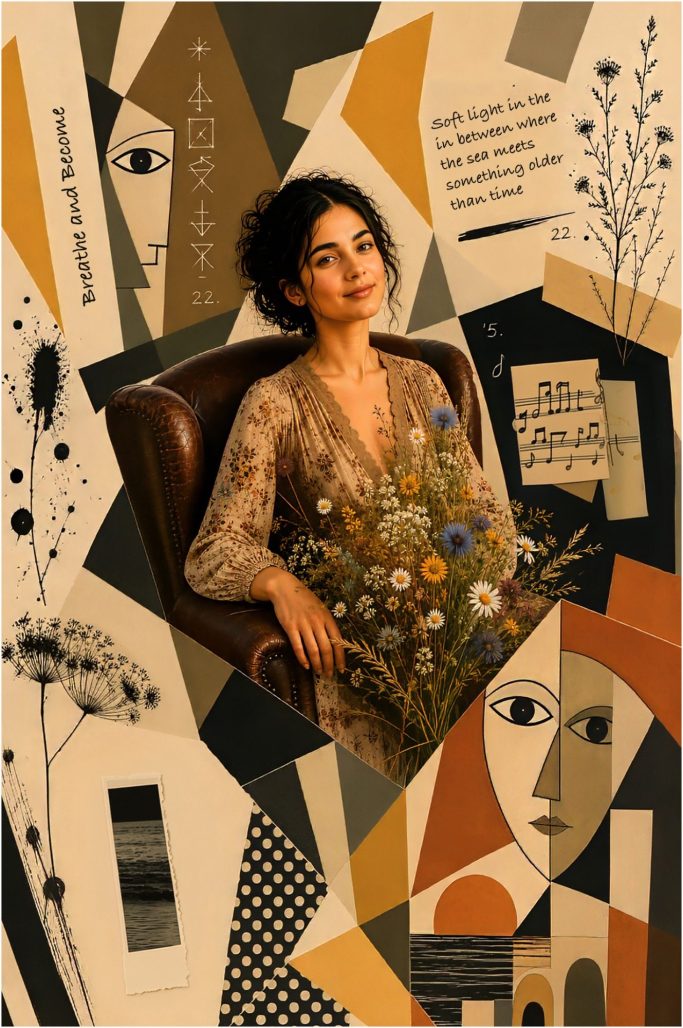
Soft Light in the In-Between, Where the Sea Meets Something Older Than Time
Soft light gathers in the in-between, not dawn, not dusk, but the quiet hour when the world loosens its edges and becomes memory. The sea waits beyond the torn window, breathing against an ancient shore, while the woman sits among flowers as though she has grown there, rooted in silence, blooming into herself.
Around her, faces divide and reassemble. Eyes watch from impossible angles. Music drifts from paper squares, unfinished and tender, like a song remembered from childhood but never completely heard. Black ink falls like weather. Wild stems rise through geometry. Everything is broken, yet nothing feels lost.
She carries the calm of someone who has crossed an invisible threshold. Her gaze is neither invitation nor farewell. It is the still centre of becoming, a place where grief has softened into wisdom and longing has learned to rest. The chair holds her body, but the collage holds her spirit: fragments of earth, shadow, salt, language, and dream.
Perhaps the older thing beneath the sea is time before names, before maps, before we learned to separate ourselves from the wind. Perhaps it is love, patient and wordless, returning in another shape. Perhaps it is the self we abandoned in order to survive.
Here, the sharp lines do not imprison her. They open pathways. Ochre becomes warmth, black becomes depth, cream becomes breath. The flowers lean toward her heartbeat. The painted eyes recognise her.
The sea continues, quietly stitching her many selves into one horizon.
And in that suspended light, she understands becoming is not a destination. It is the beautiful act of gathering every scattered piece and calling it home.

Nocturnal Studies of Avian Memories
She had travelled through life in fragments.
Not along one clear road, but through torn maps, half-lost coordinates, and imagined countries that seemed to call her name long before she fully knew herself. Those torn maps became symbols of her distant dreams: the places she longed for, the selves she might have become, the futures she carried quietly within her. They were broken, yes, but so were memory and longing. Neither ever arrived intact.
She understood that the mind was a strange nocturnal landscape. In daylight she appeared composed, but inwardly she was a shifting collage of shadow, instinct, tenderness, and unfinished thought. Her memories moved like birds across an inner sky — sudden, dark, beautiful, and impossible to hold for long. Some returned gently, carrying traces of love, wonder, and innocence. Others came weighted with absence, as though grief itself had learned to fly.
At times, it seemed that her life had not been a search for destination, but for meaning within the flight itself. Every wound, every desire, every silence had left its mark upon her. She had been divided and remade by longing. One part of her remembered, another invented, while another stood at a distance, watching, trying to understand why the soul concealed its deepest truths in symbols and dreams.
So she gathered the fragments: feathers, shadows, faces, torn maps, and the remains of distant hopes. She studied them like evidence from her own unconscious. They revealed that her journey had never been linear. It had been surreal, tender, and psychologically deep — a passage through loss, imagination, memory, and becoming.
And still she travelled, carrying her scattered dreams like wings.
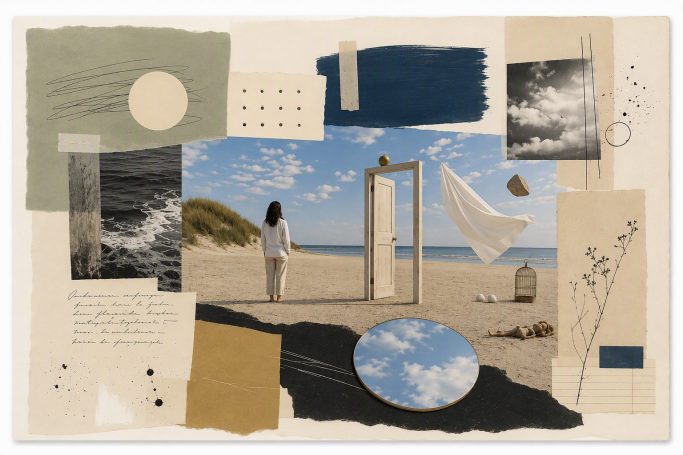
She Believed Life Was Made of Blocks. Reality Began to Escape Her Grasp
Rooms had corners. Calendars had squares. Windows divided the sky into obedient portions, and every memory could be folded, labelled, and placed inside a drawer. Even love, she thought, should have a beginning, a middle, and an ending.
But on the left, beneath the torn photograph of the restless sea, she noticed the forgotten fragments of a love letter. The handwriting was faded, the sentences broken, yet certain words returned to her: *wait, remember, always, light*. She could not recall who had written them, or whether she had replied. Still, the fragments stirred something beyond memory. They reminded her that love does not disappear because its story is unfinished.
Then the horizon loosened.
A door appeared on the beach without a wall. A white sheet lifted into the air and refused to fall. A stone hovered beside it, considering flight. At her feet, a mirror held a sky more vivid than the one above.
Reality was not escaping her, she realised. It was expanding beyond the shapes she had used to contain it.
Perhaps a life was not a structure to be completed, but a collage: torn edges, unfinished letters, accidental beauty, absences that made room for wonder. Perhaps the things we lose do not vanish; they become part of the atmosphere through which we live.
She stepped towards the open doorway.
Behind her, the world remained divided into neat compartments.
Ahead, the sea offered no promises, only possibility.
And that was enough. She understood that freedom was not the absence of uncertainty, but the courage to walk gently within it.

Live Loud. Create Freely
I wake inside a storm of colour, and every shade feels like a pulse returning. Red becomes courage. Yellow becomes breath. Green becomes the quiet certainty that something tender is beginning again. The world is no longer distant or muted; it spills toward me in fragments, splashes, torn edges, wild lettering, unfinished declarations.
I stand at the centre of it all, not polished, not hidden, not asking permission. My face carries every road, every silence, every year I thought I had to become smaller. Now the cracks shine. Now the noise sings. Now rebellion is not anger, but arrival.
Colour gathers around me like memory released from its cage. It climbs the walls of my spirit, writes hope across old wounds, paints possibility over fear. I feel the electric beauty of becoming visible to myself.
There are no rules here, only rhythm. No perfect lines, only movement. No final version, only transformation.
I am learning to inhabit the life that has been waiting for me. To be vivid without apology. To trust instinct, contradiction, mess, desire. To let joy be raw. To let love be loud. To let change enter without knocking.
Every mark says continue. Every block of colour says begin. Every rough edge says you survived.
And so I rise, painted in experience, surrounded by signs, hungry for wonder, humbled by time, awake at last.
The future does not whisper.
It shouts in colour.
I step forward with open hands, carrying fire, tenderness, mischief, scars, and gratitude, ready to meet whatever beauty chooses to find me next, now.
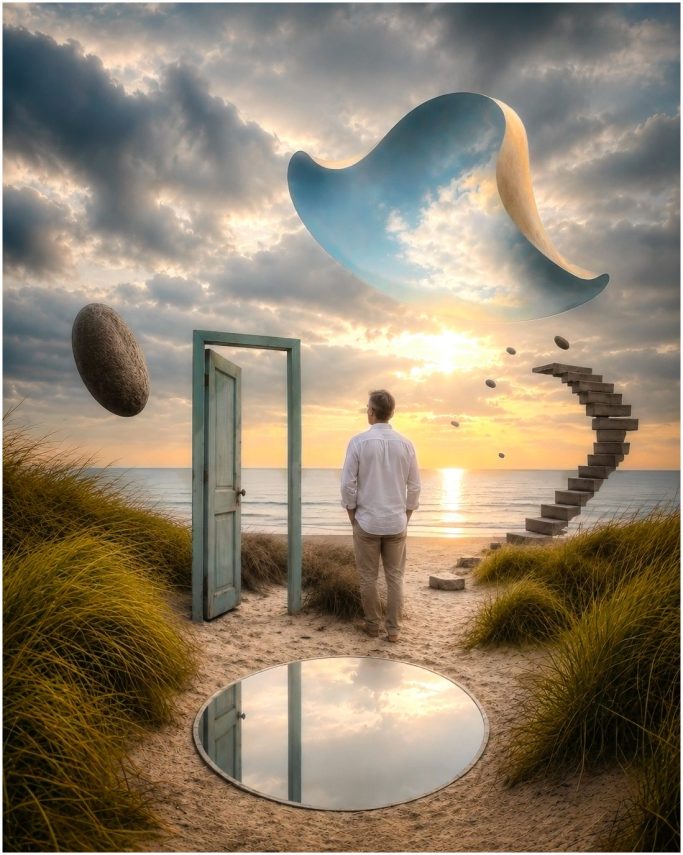
He stood on the beach in the middle of nowhere
He stood on the beach in the middle of nowhere, beneath a vanilla sky softened by distance and light. The tide had withdrawn just enough to leave the sand transformed into a mirror, a reflective threshold between what was above and what was below, what was known and what was imagined.
There was something unsettling about such stillness.
The beach appeared less like a landscape and more like a question. The horizon dissolved into ambiguity. Sky became sea. Sea became sky. The distinction between reality and reflection seemed increasingly irrelevant. Perhaps all perception was a form of reflection; perhaps we never see the world itself, only the meanings we cast upon it.
A memory surfaced.
Not a complete memory, but a fragment. A feeling without a clear origin. A presence without a face. It hovered within consciousness like a solitary star visible before dusk, refusing either to brighten or disappear.
He wondered why certain memories endure.
Most experiences pass through us like water through open hands. Yet a few remain, resisting time’s patient erosion. They become less about the events themselves and more about the questions they continue to ask. They linger because they contain something unfinished, not in circumstance but in understanding.
The reflective beach seemed to offer an answer.
A reflection is never the thing itself. It is both true and incomplete. Memory functions in much the same way. We do not preserve the past; we preserve our relationship with it. Each recollection becomes a mirror in which the observer and the observed slowly merge.
The vanilla sky stretched endlessly overhead.
The memory remained awake.
And standing between sea and sky, between presence and absence, he sensed that wisdom was not found in letting go of every memory, but in learning which ones deserve to remain open-eyed, quietly illuminating the mystery of being alive.
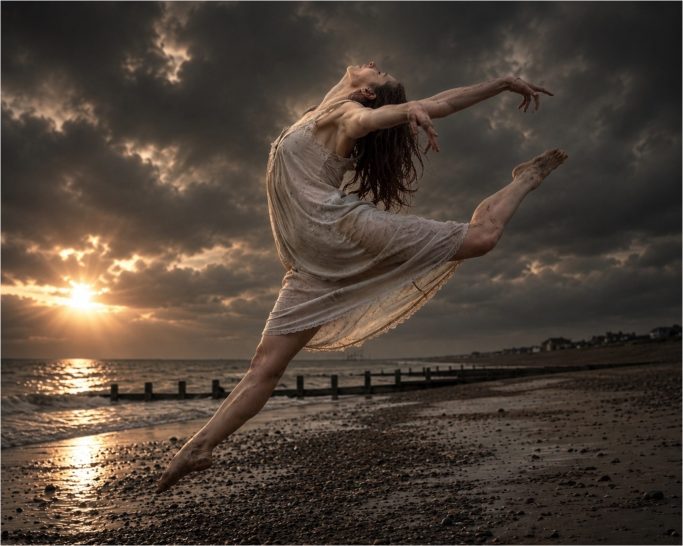
She moved by the light of the world
She moved by the light of the world.
Not the light that fell from the sun, nor the pale illumination of distant stars, but another kind entirely—the light hidden inside moments. The light that exists between one heartbeat and the next. The light that appears when a soul finally stops hiding from itself.
Emotion poured from her heart as water pours from a spring that has waited centuries beneath stone. She did not resist it. She had learned that grief and joy wear different masks yet belong to the same mysterious family. To deny one was to silence the other.
As she walked, the world seemed to breathe through her. Trees swayed with forgotten memories. The sea carried fragments of old conversations upon its restless back. Even the clouds appeared to be searching for names they once knew.
She understood then that life was not asking her to be strong.
It was asking her to be open.
For years she had mistaken protection for survival. She had built walls from caution, towers from disappointment, entire cities from unspoken fears. Yet the heart is not a fortress. It is a lantern. Its purpose is not to imprison light but to release it.
The emotions flowed outward in invisible rivers. Some became compassion. Some became longing. Some became forgiveness for wounds that had lingered too long in the shadows.
And as they left her, they did not diminish her.
They enlarged her.
She became a vessel through which existence could briefly recognise itself.
The light of the world moved through her veins. The sorrow of the world moved through her tears. The wonder of the world moved through her smile.
And for a fleeting moment she understood:
To feel deeply is not a burden.
It is the soul remembering that it belongs to everything.
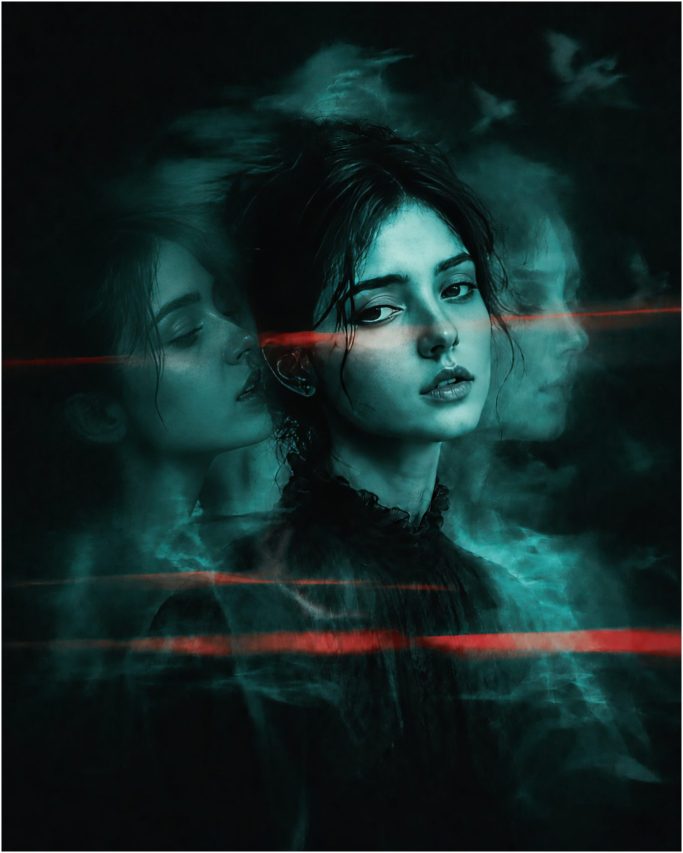
Some people do not stay; They leave traces so quiet, they feel like breath.
A warmth caught in the seam of a curtain. A flicker of red crossing the dark, then disappearing beneath the skin of the room. Nothing announces its departure. Even the mirrors keep their mouths closed.
Afterwards, there are three versions of the silence: one facing forward, one turned toward the vanished door, one with its eyes shut beneath the water. They drift through each other, blurred at the edges, carrying fragments of a name.
You try to hold them still, but memory is a poor photograph. It trembles. It doubles. It admits strange weather. A face becomes a shoreline; a shoulder becomes smoke; a final glance lengthens into a corridor lit by an ember.
Perhaps this is how absence survives: not as emptiness, but as an after-image. A colour behind the eyelids. A low tide moving through the bones. The almost-touch of a hand beside your hand, as though the air has learned tenderness and cannot stop practising it.
Outside, night gathers its blue-green machinery. Clouds turn slowly in their sleep. Somewhere, a signal crosses the sky without asking to be received.
You stand in the middle of what remains, surrounded by unfinished reflections, and understand that leaving is not always a closing. Sometimes it is a thin red line through the dark: a wound, a thread, a road no map remembers.
And sometimes, when the world is still, it is only breath—yours, theirs, or the space between—rising once, softly, before it becomes invisible.